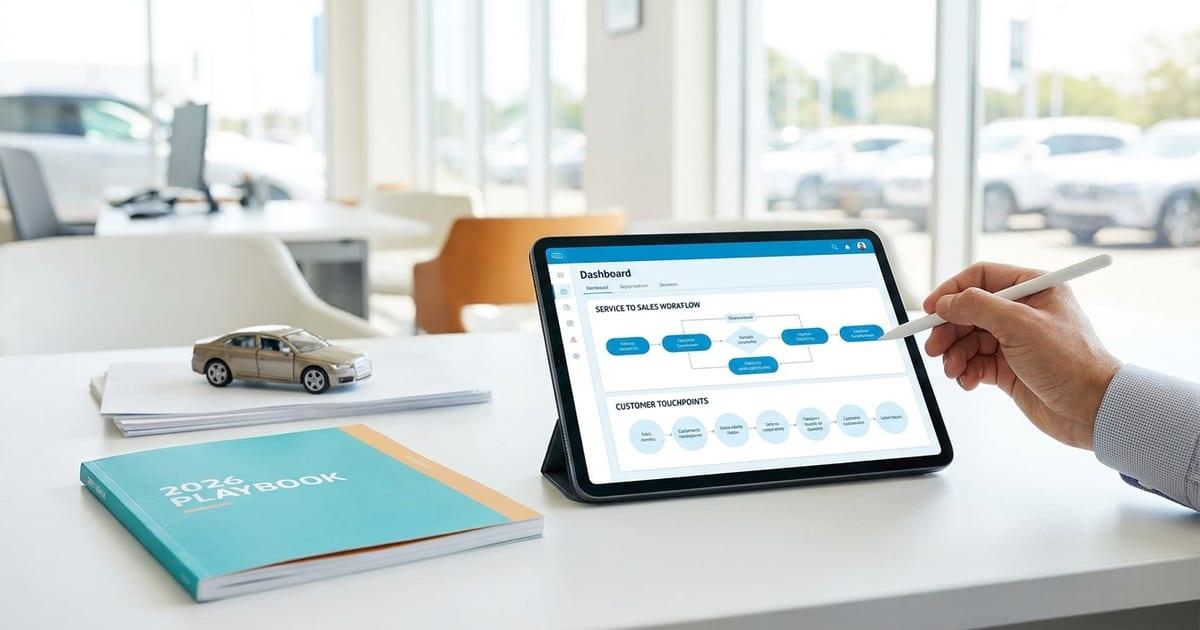
Converting Service Lane Visits into Vehicle Sales Opportunities in 2026: Proven Playbook for Automotive
Picture this: it's a Tuesday morning at your rooftop store and 47 service appointments are on the board before 9 a.m. Those vehicles belong to 47 existing customers — people who already trust your dealership enough to hand you their keys. Some of them are six months from lease maturity. A handful are underwater on a trade and don't know it yet. At least three are looking at repair estimates that will make them wince. And by 5 p.m., almost every one of them will drive off the lot without a single salesperson having said more than "have a great day." That's not a sales problem. That's a process problem — and for a Fixed Ops Director or GM trying to squeeze every dollar out of your existing traffic, it's quietly one of the most expensive gaps in the building.
The bitter irony is that service customers are your warmest prospects. Industry data consistently shows that 74% of service customers are likely to purchase their next vehicle from the dealership that services their car. Yet most stores convert somewhere between 2% and 5% of customer-pay repair orders into vehicle sales — leaving the other 95%+ to walk out the door, buy elsewhere, and return six months later for an oil change. The gap between those two numbers is where revenue goes to die, and closing it doesn't require a bigger sales team. It requires a smarter handoff.
This playbook is written specifically for Fixed Ops directors and GMs who are tired of watching their service lane generate foot traffic that never makes it to the showroom floor. We'll break down what top-performing stores are doing differently, what the actual conversion benchmarks look like, and how to build a repeatable workflow — integrated into your DMS and CRM — that turns service appointments into a predictable vehicle sales pipeline in 2026.
What Sales Teams Are Actually Saying About the Service Lane
If you spend any time in the r/askcarsales community or the r/CarSalesTraining forums, you'll notice that the frustration runs in both directions. Salespeople complain that service advisors never loop them in. Service advisors complain that salespeople swoop in at the wrong moment and kill customer trust. And both departments blame the lack of a structured process. Sound familiar?
The most upvoted advice in these communities isn't "be more aggressive in the waiting room." It's the opposite. Experienced producers consistently say the move is to pre-qualify, appraise, and follow up — making the offer feel relevant and helpful rather than like a pitch. One r/askcarsales commenter put it plainly: "Offer everyone an appraisal. Many will say no the first time, but leave a note in the car or follow up and the conversation reopens itself." That's not a hard sell — it's a soft, value-forward touchpoint that plants a seed. Understanding the psychology behind why customers respond to value-forward offers can help your team frame these interactions far more effectively.
The repair-cost trigger is where things get particularly interesting. The r/CarSalesTraining thread on service lane selling surfaces a specific number: when a customer is facing a $1,000–$2,000+ repair bill, that's the moment to involve a salesperson and reframe the conversation. "Instead of paying $1,800 to fix this transmission, what if you put that money toward a payment on something newer?" Customers who feel the math is against them are genuinely open to that conversation — as long as it doesn't feel opportunistic. The framing has to be helpful, not predatory.
The r/CarSalesTraining community also describes a practical morning workflow: compile your service leads the night before or first thing in the morning, verify equity positions in your DMS, and place appraisal hangers in vehicles when there isn't time for a live touchpoint. It's a low-friction, high-volume approach that doesn't require a dedicated equity specialist on every shift — just discipline and a process that everyone buys into. The biggest pain point practitioners identify isn't customer resistance; it's the wall between the service department and the sales floor that prevents the handoff from ever happening in the first place.
By the Numbers: What Good Actually Looks Like
Before you can improve your service-to-sales conversion rate, you need to know what you're benchmarking against. The numbers below represent the clearest industry data available for this funnel — and the gap between average and elite performance is significant enough to justify serious attention.
Service Lane Conversion Benchmarks (2025–2026)
- 2%–5% — Industry average service-to-sales conversion rate as a percentage of customer-pay ROs
- 8%–10% — Conversion rate at high-performing stores with dedicated equity specialists and structured workflows
- 74% — Likelihood that a service customer will buy their next vehicle from the dealership that services their car
- 55%–70% — Lead-to-appointment-set rate in fixed ops when a proper BDC follow-up process is in place
- 70%–82% — Appointment-set-to-show rate for fixed ops leads
- 88%–95% — Show-to-RO-written rate once a customer physically arrives
- Above 50% — Lead-to-RO-paid composite rate at strong fixed ops operations (average stores run 36%–48%)
The takeaway from these numbers is that the service lane already has excellent downstream conversion rates once customers are in the door and engaged. The problem isn't closing — it's identification and routing. Your advisors are writing ROs on high-equity vehicles every day without knowing it, because nobody has connected the DMS data to a real-time alert that flags those customers before the keys are handed back.
Consider what a modest improvement means in dollar terms. If your store writes 400 customer-pay ROs per month and you're converting at 2% (8 vehicle sales), getting to just 4% adds 8 incremental unit sales per month. At an average front-end gross of $2,500 per unit, that's $20,000 in additional gross profit — before F&I income. That's not a rounding error. That's a headcount or a marketing budget.
Strategy 1: Build a Morning Equity Review That Feeds Sales Before the Day Starts
The Problem
Hundreds of customers visit your service lane monthly, and the sales department gets zero advance notice about who they are, what they're driving, or whether they're a viable trade candidate. By the time a salesperson might wander into the drive, the customer has already been checked in, moved to the waiting area, and mentally shifted into "I'm just here for my oil change" mode. The window closes fast.
The Solution
Every high-performing store treating the service lane as a sales channel runs some version of a morning equity review meeting. Pull tomorrow's appointment manifest from your DMS (CDK Global, Reynolds & Reynolds, or whichever platform you're on) and cross-reference it against current trade values. Flag any customer who is equity-positive, within 90 days of lease end, past 60,000 miles on a vehicle prone to expensive repairs, or carrying a repair estimate over $1,000.
Implementation Steps
- Day 1: Pull the next day's service manifest from your DMS every evening. This takes five minutes if your Reynolds & Reynolds or CDK Global system is set up with the right report.
- Day 2: Assign one salesperson or an equity specialist to review the flagged customers before the morning stand-up. They should have a trade value range in hand before the customer arrives.
- During the visit: That salesperson walks the drive, greets the flagged customer by name, and offers a complimentary appraisal. The offer is framed as a benefit ("We'd love to give you a current market value on your vehicle while it's here") — not a sales pitch.
- If the customer declines: Leave an appraisal hanger in the vehicle. Follow up by SMS or email within 24 hours with a personalized trade-value estimate.
Expected Outcome
Stores that implement this morning review consistently report that the simple act of identifying the right customers before they arrive — rather than cold-prospecting the waiting room — dramatically reduces customer resistance. You're not pitching everyone; you're having a relevant conversation with the three or four people on the board who actually make sense to talk to today.
Strategy 2: Train and Incentivize Service Advisors as the First Handoff
The Problem
Your service advisors are the first humans to interact with every customer who comes through the drive. They have the customer's trust, they see the repair estimate before anyone else, and they're in the ideal position to make a warm introduction to a salesperson. But most advisors aren't trained to spot a sales opportunity, aren't compensated for making referrals, and — if we're being honest — are often quietly territorial about "their" customers. Without incentives and a clear script, the handoff never happens.
The Solution
Treat service advisors as the top of the sales funnel and build a formal referral system with two components: a simple verbal script and a tangible spiff. The script should take less than 30 seconds and should feel natural. Something like: "Hey, while we have your vehicle in today, would you like us to give you a current market value? The market's been strong and some of our customers have been surprised at what their vehicle is worth." That's it. No mention of selling a new car yet.
Implementation Steps
- Build the script: Work with your sales manager to create two or three situation-specific scripts — one for high repair estimates, one for equity-positive flags, one for lease-end proximity. Role-play them in your next department meeting. (If your team wants structured practice, AI-powered sales roleplay tools like Appendment's Practice Mode let reps rehearse objection scenarios before they go live on the drive.)
- Create the incentive: Pay advisors a flat $50–$100 spiff for every referral that results in an appraisal, and an additional $100–$150 if the appraisal leads to a sale. Track it separately in your CRM so there's no ambiguity about attribution.
- Define the handoff moment: The advisor's job ends the moment they get a "yes" from the customer. They call or text the designated sales rep immediately — not when the RO is done, not when the customer is walking to their car. The handoff happens while the customer is still in the building.
- Measure it: Track advisor referral rates in your shared DMS/CRM workflow. This is a KPI that Keyloop and similar platforms call out specifically: cross-department conversion metrics need to live in a shared system, not in someone's memory.
Expected Outcome
When advisors have a clear script, a real financial incentive, and a defined handoff moment, the "wall" between fixed ops and variable ops starts to come down. This is the cultural shift that industry sources like Automotivemastermind consistently point to as the foundation of any successful service-to-sales program. The same principle applies across service-based businesses — as explored in how home services teams reduce churn by building structured handoff workflows between their operational and sales sides.
Strategy 3: Automate the Equity Alert So No Opportunity Goes Undetected
The Problem
Manual equity reviews are better than nothing, but they depend on someone remembering to run the report, someone having time to analyze it, and someone following through before the customer arrives. In a busy 40-line service department, that chain breaks constantly. What you really need is an automated alert that fires the moment a high-equity, high-mileage, or repair-cost-trigger vehicle is scheduled — pushing the right information to the right person without anyone having to look for it.
The Solution
Tools like AutoAlert (now part of the Solera ecosystem) and Vincue are built specifically for this workflow. They integrate with your DMS to scan every incoming service appointment against live trade values, mileage thresholds, lease-end dates, and repair history — then push an alert to a salesperson or BDC rep with a pre-built offer recommendation. The salesperson doesn't need to run a report. The alert comes to them.
Implementation Steps
- Define your trigger criteria: Start with three: (1) vehicle equity above $3,000 positive, (2) mileage above 75,000 miles, (3) repair estimate over $1,000. Adjust thresholds after 30 days based on what's actually converting.
- Connect your DMS: Work with your Reynolds & Reynolds or CDK Global rep to ensure your equity-mining tool has a live feed from the service appointment scheduler. Real-time data is non-negotiable — a 24-hour lag means you miss the in-store window.
- Route the alert to the right person: The alert should go to a designated service-to-sales rep or your most experienced closer, not to a round-robin queue. Predictive routing tools — like Appendment's CloserMatch — ensure the lead goes to whoever is most likely to convert it based on skill set and availability.
- Automate the follow-up: If the customer doesn't engage during the visit, trigger a personalized SMS or email within two hours of vehicle pickup. The message should reference their specific vehicle and a real trade-value estimate — not a generic "we want to buy your car" blast. Automated follow-up sequences that personalize around customer data drive significantly higher response rates than templated outreach.
Expected Outcome
Automation eliminates the "I forgot to check" failure mode that kills most service-to-sales programs. When the system does the identification work, your salespeople can focus entirely on the conversation — which is where skill, not process, actually matters. This is the operational foundation that separates stores running 2% conversion from stores running 8%–10%.
Implementation Roadmap: From Zero to Repeatable in 90 Days
Weeks 1–2: Quick Wins
- Start pulling tomorrow's service manifest manually every evening and reviewing for obvious equity candidates
- Assign one salesperson to the service drive every morning with a clear mandate: offer appraisals to flagged customers
- Draft your advisor referral scripts and present them in a department meeting — get buy-in from your service manager
- Begin tracking service-to-sales referrals and conversions in your CRM, even if it's a manual log for now
Month 1: Foundation Building
- Launch the advisor spiff program and communicate it clearly in writing with defined attribution rules
- Implement or activate your equity-mining tool and connect it to your DMS appointment scheduler
- Define your trigger criteria (equity threshold, mileage, repair cost) and configure automated alerts
- Set shared service/sales KPIs: service-to-sales conversion rate, appraisals completed per day, referrals per advisor
- Begin a weekly cross-department review meeting (15 minutes) to discuss wins, misses, and pipeline
Months 2–3: Optimization and Scaling
- Analyze your first 30 days of conversion data — adjust trigger thresholds based on what actually converted
- Build out automated post-visit follow-up sequences for customers who received an appraisal but didn't engage
- Add a BDC role or expand your dedicated service-to-sales rep coverage to cover afternoon and Saturday traffic
- Introduce call coaching for service-to-sales conversations — reviewing talk-to-listen ratios and objection handling helps reps improve faster. Call scorecards and conversation analytics surface patterns you can't see without the data.
- Set a 90-day target: move from your baseline conversion rate to at least 4% customer-pay ROs, with a 6-month goal of 6%+
Pro Tip for GMs:
The stores that fail at service-to-sales usually don't fail because the strategy is wrong — they fail because the accountability structure isn't built. Someone has to own this number. Assign a named individual responsible for the service-to-sales conversion rate, give them the tools and authority to execute, and review the metric in your weekly managers' meeting. Process without accountability is just theory.
How Appendment Solves This for Automotive Dealerships
The three strategies above require two things to work at scale: intelligence and automation. You need to know which service customers are worth talking to, and you need the system to act on that knowledge without relying on someone to remember to check a report. That's exactly what Appendment is built for.
Appendment's Insight Engine pulls from 50+ data points — including vehicle equity, mileage, lease-maturity timelines, and repair history — to surface the service customers who are most likely to be receptive to an upgrade conversation. Instead of your team manually cross-referencing the service manifest against trade values every morning, the Insight Engine does it automatically and presents the opportunity in a prioritized, actionable format.
When the Insight Engine identifies a high-value service customer, the Show-Up Engine takes over — automatically triggering a personalized upgrade offer through the customer's preferred channel (SMS, email, or in-app) at the exact right moment. If they don't engage during the visit, the follow-up sequence fires automatically, referencing their specific vehicle and a real equity position — not a generic blast.
For the sales team handling these conversations, SalesPilot provides real-time coaching and objection battlecards during live service-to-sales conversations — so when a customer says "I'm not really looking to buy right now," the salesperson has a relevant, equity-based response ready, not a stumble. The strategies behind these live-conversation techniques mirror what top performers use on digital channels too, as covered in our guide on closing more deals on video sales calls. And because every conversation is scored through Gamefilm, your managers can identify which service-to-sales touchpoints are working and which need refinement — without sitting in on every conversation.
The result is a service-to-sales workflow that runs with the consistency of a machine and the personalization of your best salesperson — a combination that's very hard to achieve with manual processes alone. Explore what this looks like for your specific store at Appendment for Automotive, or book a 20-minute demo to see the Insight Engine and Show-Up Engine in action.
Frequently Asked Questions
How many service customers should a dealership expect to convert into vehicle sales each month?
Industry benchmarks place the average at 2%–5% of customer-pay ROs, meaning a store writing 400 ROs per month should expect 8–20 incremental vehicle sales from the service lane if the process is working. High-performing stores with dedicated equity specialists and automated workflows report 8%–10% conversion — roughly double the industry standard. Your baseline will depend on your current DMS data quality, advisor engagement, and whether you have a structured handoff process in place.
How long does it take to see results from a service-to-sales program?
Most stores see measurable improvement in the first 30 days if the morning equity review and advisor referral script are in place, because you're immediately capturing in-the-moment opportunities that were previously invisible. Meaningful conversion rate improvement — moving from 2% to 4% or better — typically takes 60–90 days as the advisor habits solidify, the equity alert automation is calibrated, and the follow-up sequences are optimized based on real response data.
What tools do automotive dealerships use to identify service-to-sales opportunities?
The most common technology stack includes an equity-mining tool (AutoAlert, Vincue, or similar) integrated with the store's DMS — typically CDK Global or Reynolds & Reynolds — plus a CRM for tracking referrals and follow-up. Forward-thinking stores are adding AI-powered platforms like Appendment's Insight Engine to automate the identification and routing layer, eliminating manual report-running and ensuring no high-value appointment goes unnoticed. The BDC is also increasingly involved in the post-visit follow-up sequence, particularly for customers who received an appraisal but didn't engage same-day.
How does AI help with converting service lane visits into vehicle sales opportunities?
AI improves service-to-sales conversion at three stages of the funnel: identification (automatically flagging customers with equity, mileage, lease-timing, or repair-cost triggers before they arrive), engagement (personalizing the offer and delivery channel based on customer history and preferences), and follow-up (triggering sequenced outreach that references specific vehicle data rather than generic messaging). The practical impact is that AI handles the pattern-recognition and timing work that would otherwise require a dedicated equity specialist — allowing smaller teams to operate with the consistency of a much larger operation. Tools purpose-built for automotive workflows, like those explored at Appendment for Automotive, are increasingly offering these capabilities natively integrated with dealership DMS platforms.
Interactive Call Scorecard
Score your live sales conversations on talk-to-listen ratios, objection handling, and closer readiness.
Related Tags
Michael Giannulis has spent over 20 years in direct response marketing, producing copy and building revenue systems for hundreds of organizations with combined attributed revenue exceeding $25 million. He is the founder of Appendment, Dictate, and RunFrame, an MBA graduate from Western Governors University, and a PhD candidate in Biblical Exposition at Liberty University.