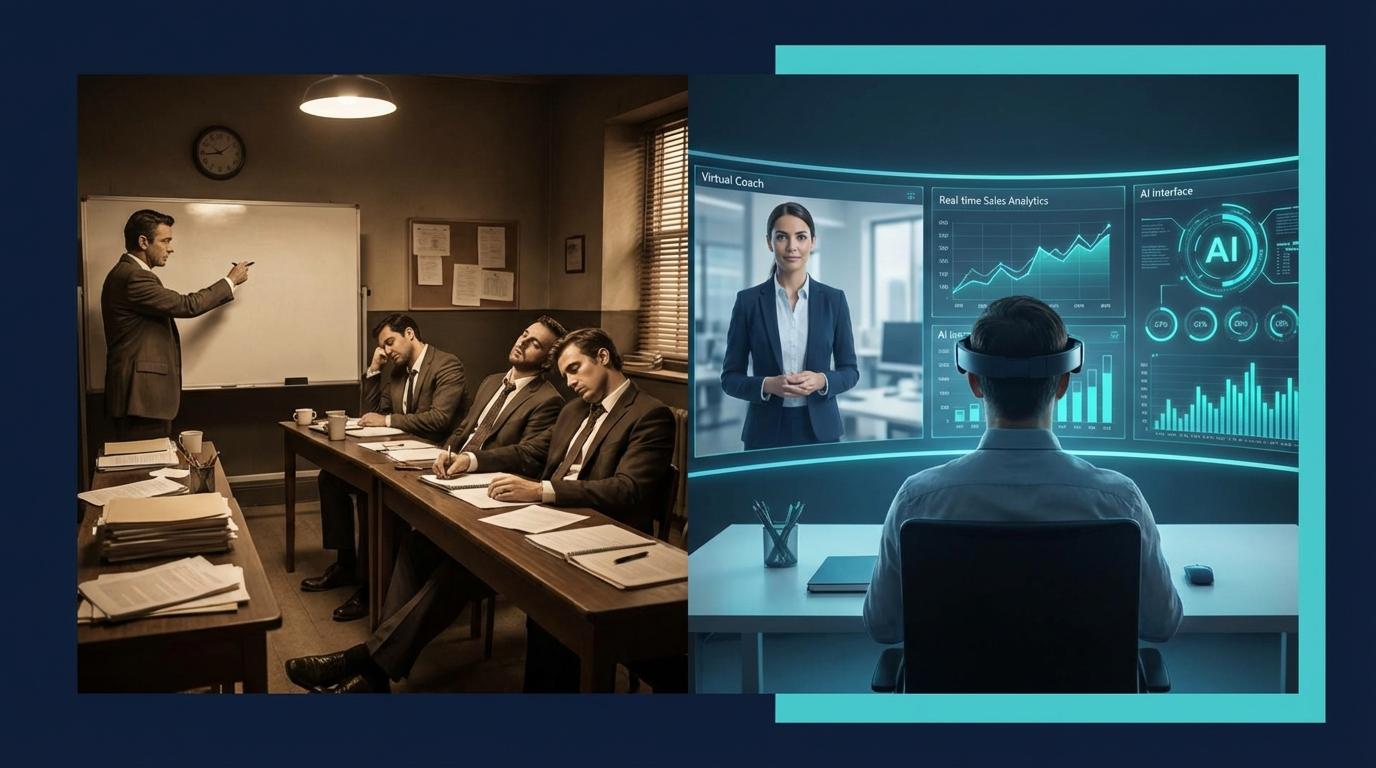
AI Sales Coaching vs. Traditional Sales Training: What Actually Works in 2026
The global sales training industry generates over $70 billion in annual revenue. Companies pour thousands of dollars per rep into workshops, seminars, online courses, and certification programs, convinced that training is the path to better sales performance. And yet the data tells a troubling story: according to the Sales Management Association, 87 percent of sales training content is forgotten within 30 days. Gartner reports that only 25 percent of sales organizations believe their training programs effectively improve performance.
That means roughly $50 billion is being spent annually on training that does not stick. Not because the content is bad, but because the delivery model is fundamentally mismatched with how adults actually learn, retain, and apply new skills in high-pressure selling environments.
The emergence of AI-powered sales coaching in 2025 and 2026 has created a genuine alternative to the traditional training model. But this is not another "AI will replace everything" narrative. The reality is more nuanced, and the most effective approach for most organizations is a hybrid model that leverages the strengths of both. This analysis breaks down the data so you can make an informed decision about where to invest your training budget.
The Retention Problem: Why Training Doesn't Stick
Before comparing the two approaches, it is important to understand why traditional sales training struggles with retention. The problem is rooted in well-established cognitive science that the training industry has largely ignored.
Hermann Ebbinghaus's forgetting curve, first documented in 1885 and repeatedly validated since, shows that humans forget approximately 70 percent of new information within 24 hours and up to 90 percent within a week unless the information is actively reinforced. Traditional sales training, delivered in concentrated blocks of one to three days, runs directly into this cognitive wall.
A rep who attends a two-day sales methodology workshop learns a structured approach to discovery, objection handling, and closing. They practice role-plays in the workshop setting. They leave feeling motivated and equipped. Then they return to their desk, face the pressure of their pipeline and quota, and within two weeks they have reverted to their old habits because the new skills were never reinforced in the context of actual selling situations.
This is not a failure of willpower. It is a failure of instructional design. Cognitive science shows that lasting skill development requires spaced repetition (reviewing material at increasing intervals), contextual application (practicing in real situations rather than simulated ones), and immediate feedback (knowing whether you applied the skill correctly while the experience is fresh).
Traditional training delivers concentrated knowledge in low-stakes environments. AI coaching delivers distributed reinforcement in high-stakes environments. This fundamental difference in delivery context explains the dramatic difference in retention and behavior change outcomes.
Head-to-Head Comparison
The following comparison evaluates traditional sales training and AI sales coaching across six critical dimensions. Each assessment is based on published research, industry benchmarks, and observed outcomes from organizations using both approaches.
| Dimension | Traditional Training | AI Sales Coaching |
|---|---|---|
| Timing | Scheduled events (quarterly/annual), disconnected from selling moments | Real-time during live calls and interactions, exactly when skills are needed |
| Retention Rate | 13% after 30 days (Ebbinghaus curve), requires expensive reinforcement programs | Up to 75% through spaced repetition and contextual reinforcement during actual selling |
| Cost Per Rep | $1,500-$5,000 per event plus travel, lost selling time, and opportunity cost | $100-$300/month per rep, continuous access with no downtime from selling |
| Scalability | Limited by trainer availability, venue capacity, and scheduling logistics | Unlimited, instant deployment across all reps regardless of location or time zone |
| Personalization | One-size-fits-all curriculum, limited ability to address individual weaknesses | Adapts to each rep's skill gaps, learning pace, and specific selling situations |
| Measurement | Survey-based satisfaction scores, difficult to correlate with revenue outcomes | Direct measurement of behavior change, skill adoption, and revenue impact per rep |
How Real-Time AI Coaching Actually Works
To understand why AI coaching produces dramatically better retention and performance outcomes, it helps to understand the mechanics of how it operates during a live sales interaction.
AI sales coaching platforms like Appendment's SalesPilot work by listening to the conversation in real time, understanding the context (who the prospect is, what industry they are in, where they are in the buying process), and providing the rep with contextual prompts, data points, and suggested approaches at the exact moment they are needed.
During the Discovery Phase
When a rep begins a discovery call, the AI provides a pre-call brief with prospect intelligence and suggested discovery questions tailored to the prospect's industry and likely pain points. As the conversation unfolds, the AI surfaces additional questions based on what the prospect reveals. If the prospect mentions they are migrating from one system to another, the AI might prompt: "Ask about timeline, who is driving the initiative, and what happens if the migration does not go as planned." This is not scripted selling. It is intelligent augmentation that helps the rep explore the right topics at the right depth.
During Objection Handling
When a prospect raises an objection, the AI recognizes the objection category and provides the rep with suggested responses drawn from what has worked for top performers facing the same objection in similar selling contexts. Crucially, it provides multiple response options so the rep can choose the approach that fits their personal style and the specific conversation dynamic. A pricing objection from a mid-market manufacturing company gets a different suggested response than the same objection from an enterprise logistics firm.
During the Close
As the conversation moves toward closing, the AI tracks which buying signals the prospect has given (or not given) and alerts the rep to potential gaps. If the prospect has expressed strong interest in the solution but has not mentioned budget authority or timeline, the AI might prompt: "Budget and timeline not yet confirmed. Consider asking: What does your approval process look like for a project like this?" This ensures reps do not leave calls without the critical information needed to advance the deal.
Industry-Specific Coaching Differences
One of the most significant advantages of AI coaching over traditional training is the ability to provide industry-specific guidance. Traditional training typically teaches generic sales methodology that reps must then translate to their specific market. AI coaching delivers guidance already contextualized for the rep's industry and specific selling situation.
Freight Brokerage
For freight brokerage sales teams, AI coaching provides lane-specific rate intelligence, carrier capacity data, and market trend context during live negotiations. When a new broker is negotiating a rate with a carrier, the AI surfaces the current market rate range, the carrier's historical reliability on that lane, and competitive rates. Traditional training can teach negotiation principles, but it cannot provide the real-time market data that makes those principles actionable in the moment.
MSP and IT Services
MSP sales teams benefit from AI coaching that provides technical context and competitive intelligence during prospect conversations. When a prospect asks about specific technologies or compliance requirements, the AI provides technically accurate, business-value-framed responses that the rep can deliver without needing to escalate to an engineer. This is knowledge that traditional training cannot effectively deliver because it requires constant updates as technology evolves.
Industrial Manufacturing
Manufacturing sales teams face unique challenges around technical specification knowledge, application engineering, and competitive product cross-referencing. AI coaching helps reps navigate complex technical conversations by providing specification data, application recommendations, and competitive differentiators in real time. A traditional two-day training workshop cannot cover the breadth of technical knowledge needed across hundreds or thousands of product SKUs and applications.
The Hybrid Approach: Best of Both Worlds
Despite the compelling data favoring AI coaching for skill development and retention, traditional training still offers unique value that AI cannot fully replicate. The most effective sales organizations in 2026 are adopting a hybrid approach that leverages each method's strengths.
Where Traditional Training Excels
- Foundational methodology: Teaching a core sales framework (MEDDIC, Challenger, Sandler, etc.) requires the structured curriculum and group discussion that classroom training provides well
- Culture and mindset: Team-building, motivational content, and organizational culture reinforcement benefit from the shared experience of in-person events
- Complex role-playing: Multi-person selling scenarios, negotiation simulations, and presentation practice are still best done in facilitated group settings
- New product launches: Introducing entirely new products or markets benefits from dedicated, focused training time away from daily selling activities
Where AI Coaching Excels
- Skill reinforcement: Ensuring the methodology learned in training is actually applied during real sales conversations
- Knowledge delivery: Providing real-time access to product, market, and prospect intelligence that changes too frequently for static training
- Individual coaching: Identifying and addressing each rep's specific weaknesses with personalized guidance at scale
- New hire onboarding: Accelerating ramp time by providing real-time guidance during the critical early months when new reps lack experience
- Performance measurement: Directly tracking whether training concepts are being applied and correlating specific behaviors with revenue outcomes
Implementation Roadmap for the Hybrid Model
For organizations looking to transition from a purely traditional training model to a hybrid approach, here is a practical implementation plan that minimizes disruption while maximizing the performance improvement from AI coaching.
Phase 1: Assess and Baseline (Weeks 1-4)
Audit your current training program and document the specific skills, knowledge, and behaviors each component is designed to develop. Establish baseline metrics for training retention, skill application rates, and the correlation between training completion and sales performance. This assessment will reveal which elements of your current program are working and which are essentially wasted investment.
Phase 2: Deploy AI Coaching for Reinforcement (Weeks 4-8)
Start by deploying AI coaching as a reinforcement layer for your existing training. If your training teaches a specific discovery framework, configure the AI coaching to prompt reps to use that framework during live calls. This approach validates the impact of AI coaching without disrupting your existing training infrastructure. Measure whether reps who use the AI coaching retain and apply training concepts at higher rates.
Phase 3: Shift Knowledge Delivery to AI (Weeks 8-16)
Move product knowledge, competitive intelligence, and market data delivery from static training modules to the AI coaching platform. This frees up classroom training time for the higher-value activities that require human facilitation (methodology, culture, complex scenarios) while ensuring that knowledge is available in real time rather than delivered once and forgotten.
Phase 4: Optimize the Blend (Ongoing)
Continuously analyze which skills and behaviors are best developed through traditional training versus AI coaching. Over time, most organizations find that they can reduce their traditional training events from quarterly to biannual while dramatically improving actual skill application through continuous AI reinforcement. The budget saved on reduced training events more than covers the AI coaching investment, resulting in both lower cost and better outcomes.
The Bottom Line: ROI Comparison
Let us compare the economics of the three approaches for a sales team of 20 reps over a 12-month period.
Traditional Training Only: Two events per year at $3,000 per rep, plus travel and lost selling time. Total cost: approximately $150,000. Expected performance improvement: 5 to 10 percent for 2 to 3 months post-training, then regression to baseline. Annualized revenue impact: modest and temporary.
AI Coaching Only: $250 per rep per month continuous. Total cost: approximately $60,000. Expected performance improvement: 15 to 25 percent sustained year-round. Annualized revenue impact: significant and compounding as the system learns.
Hybrid Model: One annual training event ($50,000) plus AI coaching ($60,000). Total cost: approximately $110,000. Expected performance improvement: 25 to 40 percent sustained. Annualized revenue impact: the highest of the three approaches, combining foundational methodology with continuous reinforcement.
The question is not whether AI coaching will replace traditional sales training. It is whether your organization will continue spending the majority of its training budget on approaches with 13 percent retention rates or shift to a model that delivers continuous improvement at lower cost. The data is clear. The organizations that make this shift in 2026 will have a significant competitive advantage over those that do not. Explore Appendment's AI sales enablement platform.
Ready to transform your sales training approach? Book a demo to see how AI coaching can improve performance and retention at scale.